Victor Cayres, Piano
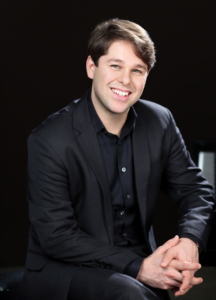
Hailed as “spirit of a leader!” by La Liberté (Fribourg, Switzerland), Brazilian pianist Victor Cayres has earned praise for concerts with the Sine Nomine string quartet and as soloist with such orchestras as Boston Pops and Brno Philharmonic in the Czech Republic. He has been a guest artist at Banff Center for the Arts in Canada, Interlochen Center for the Arts, Boston University Tanglewood Institute, Claflin University, Illinois Wesleyan University, Western Washington University, Moscow’s Tchaikovsky Conservatory and State University for Arts and Culture. He has released recordings for Albany Records, Parma Records, Centaur Records, with works by American contemporary composers David Owens, Joseph Summer, and John H. Wallace. Mr. Cayres frequently performs in Brazil, Europe, and in prestigious venues in the U.S., such as Weill Hall at Carnegie Hall, Chicago’s Preston Bradley Hall, Boston’s Symphony Hall and Jordan Hall. His concerts have been broadcast live at Brazil’s TV Cultura channel, Boston’s WGBH 99.5 All Classical, and Chicago’s WFMT Fine Arts Radio.
Victor Cayres has appeared as soloist with NEC Philharmonia, Sioux City Symphony Orchestra, Symphony Pro-Musica, Boston University Symphony Orchestra, Orquestra Petrobras Pró-Música, Orquestra Sinfônica Brasileira, Orquestra Sinfônica and Orquestra de Câmera at University of São Paulo, collaborating with such conductors as Ronaldo Bologna, Mark Churchill, Marc David, Ryan Haskins, Gil Jardim, Keith Lockhart, Norton Morozowisk, Donald Palma, Roberto Tibiriçá, and Jan Zbavitel. Under the direction of Theophanis Kapsopoulos he has toured Czech Republic and Switzerland with the Orchestre des Jeunes de Fribourg.
Mr. Cayres has gathered several prizes in national and international piano competitions, including the 8th Iowa Piano Competition, Boston University Concerto Competition and Richmond Piano Competition, 18th Leoš Janáček International Piano Competition in Brno (Czech Republic), Gina Bachauer South American Competition, Nelson Freire International Competition, Petrobras International Competition, Magdalena Tagliaferro Competition, Artlivre International Competition, as well as European competitions such as Sommerfestspiele Klavier Wettbewerb in Murten, Switzerland.
Mr. Cayres studied with Rosélys Alleoni, Gilberto Tinetti, and Eduardo Monteiro in São Paulo, Brazil, and with Wha Kyung Byun and the late Anthony di Bonaventura in Boston. He also studied for one year at the Hochschule für Musik in Karlsruhe, Germany, while appearing in concert venues in Switzerland. He currently serves as piano faculty at New England Conservatory Preparatory School, Rivers School Conservatory, Visiting Lecturer at Boston University School of Music, as well as Co-Director for Boston University Tanglewood Institute Young Artists Piano Program.
Interview
Tell us how you became a musician. Did it start in childhood, and was your first instrument the piano?
My two older sisters played piano and I would go to the music school with them every week until I was old enough to start lessons. Before putting my hands on an instrument, however, I enrolled in karate classes which used to happen in the basement of that music school, and only a few months later did I get initiated in music, first on organ then piano when I was around 12-13 years old.
Your bio states that you perform often in Brazil, as well as the United States. Do you have a special connection to Brazil?
Yes, I was born there and big part of my family is still there, parents, sisters, and cousins. I moved to the U. S. in 2004 to pursue graduate studies and have lived here ever since.
You’re currently on the piano faculty of New England Conservatory Preparatory School, a visiting lecturer at BU School of Music, and hold other faculty and guest positions. How do your interactions with students enhance your own musicianship, and how do students respond to your imparting your knowledge to them?
Whenever I share my experience with young musicians, it becomes immediately evident that we can’t teach everybody in the same way. For me, learning how to engage with each individual student is what makes teaching equally interesting and challenging, especially when considering the fact that the way I have been taught music before is not always in synch with how students learn content these days. Each one has a different timing and need, and my hope at the end of each lesson or class is to impart at least one thing that they can find useful in the future. This thought alone is what motivates me to strive to be a good role model for them which, in turn – and hopefully – is what keeps my musicianship constantly evolving, changing.
You’ve released recordings by American contemporary composers, and we’re very excited about your playing Gershwin’s “Rhapsody in Blue” with the WPO on March 8. What draws you to this type of music, and Gershwin in particular?
My dad is a jazz fan, so I grew up listening to jazz and big bands at home, including Boston Pops. In fact, Rhapsody in Blue is one his favorite musical works, with its unique sound world that feels very nostalgic of my early years at home in Brazil listening to old LPs, so I feel tremendously proud and blessed to be able to perform it with the WPO. Besides, Gershwin’s music has so many facets, at times fun and extravagant, at times lyrical and sentimental, a little bit of everything for everyone in the audience to have a good time.
March 8 will be your third time playing with the WPO as the guest soloist. How do you feel about playing with the orchestra, and your past experiences with us?
Wow, haven’t realized it is my third time! I always love the welcoming atmosphere and serious dedication of everyone involved. Your music director, Michael Korn, does an amazing job of bringing all players together in a friendly, respectful, and professional way to make music of the highest possible quality. It inspires me to work hard and prepare well for the concert.